Separate Main Vocal from Back Vocals with AI
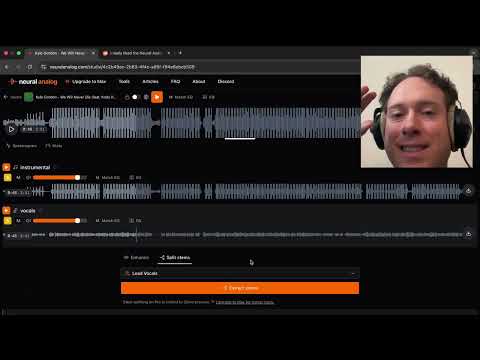
Splitting a lead singer from their backing vocalists is like trying to separate a soloist from a choir. Because everyone is using their human voice, the sounds are very similar. Standard AI often gets confused and groups all the voices together. To separate them cleanly, you need a model that can "hear" the difference between the main melody and the supporting harmonies.
The Spatial and Spectral Challenge
In the past, engineers tried to separate vocals by looking at where they were placed in the speakers. The lead singer is usually right in the middle, while backing vocals are often pushed to the sides. Modern AI still uses this trick, but it also uses a "musical ear" (attention mechanisms). The AI learns to recognize that the lead singer is the one driving the melody, while the backing vocalists are usually responding or singing longer, stacked notes.
Performant Architectures for Lead/Back Separation
- MelBand Roformer (Karaoke Models): This is currently the best tool for the job. It uses the "Mel-scale" (a scale that mimics how human ears perceive pitch) to focus on the lead vocal's signature. This allows it to "pluck" the main singer out and leave the harmonies behind.
- MDX-Net (e.g., Kim_Vocal Models): This is a classic open-source architecture. While it's great for pulling all vocals out of a song, engineers often use it in a "chain" (cascade) to slowly filter out the lead singer from the backing tracks.
- SCNet XL: This is a high-power model that is great at handling messy tracks. It excels even when the backing vocals are singing the exact same notes as the lead singer, making it a powerful tool for complex pop and rock arrangements.
- LASS / AudioSep: This model allows you to use text commands (arXiv:2308.05037). You can literally tell it to "isolate the lead singer" or "extract the choir." It uses its understanding of language to figure out which voice is which.
The "Segment Anything" Breakthrough for Audio
Most AI separation tools can only find specific things like "vocals" or "drums," but a new type of "generalist" AI can find almost anything you describe. This is called **Language-queried Audio Source Separation (LASS)**, and it works like a search engine for sound.
Based on research like "Separate Anything You Describe" (AudioSep), these models use both sound and language to understand the world. They are trained on millions of labeled sounds (from the AudioSet library) so they can understand what a "siren" or a "tambourine" sounds like without being specifically programmed for them.
This allows you to pull out rare sounds (like a specific synthesizer or a unique background noise) that standard models would ignore. While it's still experimental, it's a powerful tool for finding specific sounds that "normal" AI just can't see.
SAM Audio Performance Benchmark vs. State-of-the-Art models (source)
| Model | SAM Audio net win rate | Separation score |
|---|---|---|
| SAM Audio | Reference | 100.0 |
| LALALAI | 8.4% | 91.6 |
| AUDIOSHAKE | 11.4% | 88.6 |
| DEMUCS | 17.6% | 82.4 |
| MOISESAI | 19.5% | 80.5 |
| FADR | 28.3% | 71.7 |
| SPLEETER | 52.8% | 47.2 |
| CLAPSEP | 92.4% | 7.6 |
| FLOWSEP | 93.2% | 6.8 |
| SOLOAUDIO | 95.4% | 4.6 |
| AUDIOSEP | 98.1% | 1.9 |
Research proves that newer AI models are much better at telling voices apart. While older models might leave some backing vocals in the lead track, modern systems use 'multimodal texture' understanding to keep the lead vocal completely solo.
Realtime vs. Offline: Why Fast Separation Isn't Always Best
The difference between "instant" separation and high-quality separation is the amount of math being done. Many tools split audio instantly in your browser, but they often sacrifice quality to save on computer costs.
Lightweight models (Fast but Risky)
Early models like Spleeter treat audio like a picture (spectrogram). They were inspired by medical tools used to look at X-rays (U-Net). While these are fast and can run on a normal phone or laptop, they often leave "metallic" or robotic noises in the audio because they aren't smart enough to hear the fine details of the instruments.
High-Fidelity models (Slow but Studio-Quality)
Modern kings like HTDemucs and BS-RoFormer use "Transformers"—the same tech behind ChatGPT—to look at every tiny piece of the sound at once. These models are incredibly smart but require massive computer power.
Because these "Transformer" models do billions of calculations, they can't run instantly. To get a perfect, studio-quality result without any weird artifacts, you have to use powerful industrial-grade GPUs. Instant separation is convenient, but offline processing is how you get professional results.
The Data Paradigm: Why Architecture Isn't Everything
In the world of AI, what the model has "heard" is often more important than how it is built. Even an older AI can become a master if it is trained on massive amounts of high-quality music. It's like a student—the better the textbooks, the smarter the student becomes.
The Challenge of Copyrighted Data
AI models need to hear a lot of music to learn, but most professional songs are protected by copyright. Historically, researchers only had small, open-source collections like MUSDB18-HQ (about 10 hours of music). The best models today win because they have access to private libraries with thousands of tracks. For example, the **BS-RoFormer** model reached record-breaking scores (up to 11.99 dB) because it was "fed" a massive, private catalog of studio recordings.
The Synthetic Data Advantage
Researchers also use "fake" music to teach AI. A famous paper called "Cutting Music Source Separation Some Slakh" showed that using perfectly clean, computer-generated music (MIDI) helps the model learn much faster than using noisy real-world recordings.
Objective Quality & Benchmarks
To see how these tools work, you need to understand the math that measures their quality. This helps you compare different models on community leaderboards with confidence.
| Metric | Simple Definition |
|---|---|
| SDR | Signal-to-Distortion Ratio: The overall quality of the sound (higher is better). |
| SIR | Signal-to-Interference Ratio: How much 'bleed' from other instruments is left (higher is better). |
| SAR | Signal-to-Artifacts Ratio: How natural the sound is, without robotic glitches (higher is better). |
Lead/Back Vocals Leaderboard
This leaderboard compares how well AI can split main and backing vocals. The top-ranking models like SCNet and MelBand Roformer are the current industry leaders for this task.
Community leaderboards help you see which models actually perform best in the real world. For deep-dive benchmarking, the community maintains rankings on MVSEP based on objective math (SDR scores). Many commercial tools actually use the same "engines" as these open-source models, so checking these charts is like looking under the hood of a car to see the real horsepower.
Principles for Clean Vocal Isolation
- The Cascade Trick: To get the cleanest results, don't try to do everything at once. First, use an AI to separate all the vocals from the music. Then, take that vocal track and run it through a second AI that is specifically tuned to split the lead from the backing voices.
- Strength in Numbers (Ensembles): No AI is perfect. Often, the best results come from running two or three different models and blending their outputs together. This helps smooth out any glitches or "ghost" voices that a single model might miss.
- Hardware is Key: Splitting voices is a heavy math problem. It works much better on enterprise-grade GPUs than on a standard home computer. Running these complex workflows on a basic CPU is often too slow and less accurate.