Neural Analog guide
User guideFinish an AI song or repair an audio file
Import from AI music platforms or your own files. Restore missing frequencies and compression artifacts, split problem stems, master the cleaner version, or turn audio into MIDI—all in one Studio that keeps the source and every result.
This walkthrough shows how an imported AI song moves through restoration and review in Studio.

The basic workflow
- Import. Upload one or more files, or paste a supported public song, playlist, or creator link. Importing does not start a model or use processing minutes.
- Continue in Studio. A completed single import opens automatically. The top row is the full song; extracted or imported stems appear below it.
- Choose the task. Use Pipelines for a complete workflow, Enhance for one model, or Stems for separation.
- Optionally select a range. Drag on the waveform to process a section. Hold Ctrl/Command while dragging for SAM Audio or Stable Audio 3 prompt regions.
- Review and start. The imported file is already the default source. Change Source only to process another version, a stem, or a current mix. Confirm the processing estimate, then wait for the live status.
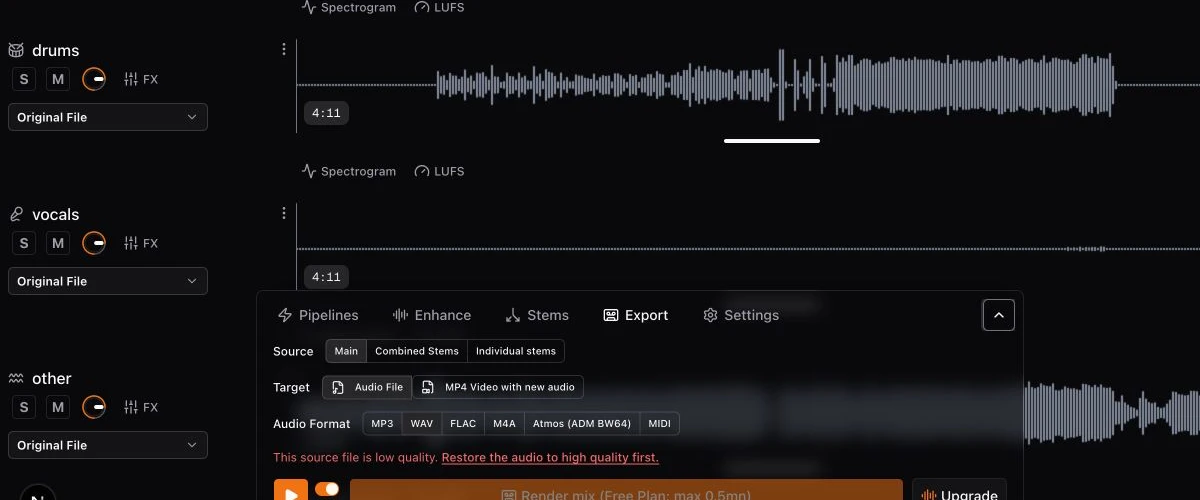
Choose a task
| Need | Start with | Result |
|---|---|---|
| Repair a compressed MP3 or web import | Restore MP3 Quality | Restored audio |
| Improve damaged detail in an AI song | Upscale AI Audio | 48 kHz restored audio |
| Remove noise or hiss | Remove noise and hissing | Cleaner audio |
| Separate vocals and instruments | 4 stems | Four stem tracks |
| Prepare a song for release | Restore and master | Restored and mastered audio |
| Turn a song into editable notes | Transcribe Stems to MIDI | MIDI stem versions |
| Create a new interpretation | Neural Remix | Regenerated audio |
Review the new version
Open the track's version menu. Processed versions are color coded: Restored, Mastered, and MIDI.
Select a processed version and use its Before / After slider to compare it with the source. Then continue to Export audio.