Spleeter vs Demucs in 2026: Benchmarks and What Beats Both
Spleeter vs Demucs comes down to speed versus quality. Demucs separates stems more cleanly (9.0 dB SDR for fine-tuned Demucs v4 versus 5.9 dB for Spleeter), while Spleeter is much faster and runs comfortably on a modest CPU. In 2026, newer models such as BS-RoFormer score higher than both.
| Spleeter | Demucs v4 (HT Demucs) | |
|---|---|---|
| Made by | Deezer, 2019 | Meta AI Research, 2022 |
| How it works | Masks a spectrogram (U-Net) | Waveform and spectrogram branches with a Transformer |
| Quality (SDR on MUSDB18) | 5.9 dB | 9.0 dB (fine-tuned) |
| Speed | Very fast, fine on CPU | Slower, best with a GPU |
| Stems | 2, 4, or 5 | 4, or 6 with guitar and piano |
| Best for | Quick previews, karaoke, batch jobs | Clean stems for remixes and releases |
If you've tried to extract vocals or make an instrumental for a remix, you've probably used a tool built on one of them. Both open-source models became reference points for stem separation, and comparing them still shows the tradeoffs between speed, artifacts, and quality.
What Are Stems and Why Is Separating Them So Difficult?
Stems are the individual components of a mixed song, typically vocals, drums, bass, and everything else. Producers work with them in the studio before the final mix combines everything.
Separating them after mixing is like trying to unbake a cake. Instruments share the same frequency range. A vocal's harmonics overlap with guitar frequencies. Kick drum transients step on bass notes. Cymbal crashes spread across the whole stereo field. Traditional signal processing left warbly, artifact-heavy results.
Deep learning improved this by training neural networks to recognize patterns that classical signal processing missed. Spleeter and Demucs became the two reference models, and they take very different approaches.
History: Spleeter vs Demucs and the Paris Connection
Spleeter: Fast Spectrogram Masking from Deezer
In November 2019, the French streaming service Deezer released Spleeter as a free, open-source tool. The team, led by Romain Hennequin, built it on TensorFlow around a U-Net convolutional neural network that works on magnitude spectrograms (time-frequency representations of the audio).
Spleeter treats separation like image segmentation. It predicts a soft mask for each time-frequency bin, estimating how much of it belongs to vocals, drums, bass, or other. An optional Wiener filtering step refines the masks, and the stems are rebuilt using the original mixture's phase.
Spleeter's strength is speed. It separates a four-minute track in seconds, reaching 100x real-time speed on GPU, and it runs comfortably on modest CPUs. It offers 2-stem (vocals/accompaniment), 4-stem, and 5-stem configurations. It became a research baseline and powered countless YouTube remix channels.
Demucs: Waveform-Domain Separation from Meta
While Spleeter focused on speed, Meta AI Research (then Facebook AI Research) focused on quality. Alexandre Défossez (also French) and his team introduced Demucs in 2019 (short for Deep Extractor for MUlti-Channel Sources) with a very different approach.
Instead of spectrograms, Demucs works directly on raw waveforms and treats separation as a time-domain reconstruction problem. Its architecture combines a U-Net-style convolutional encoder-decoder (inspired by Wave-U-Net) with a bidirectional LSTM bottleneck. This lets the network capture long-term musical structure and keep phase coherent.
Demucs evolved through four major versions:
- v1 (2019): Pure waveform approach, already rivaling spectrogram methods
- v2 (2020): Refined training and efficiency improvements
- v3 "Hybrid Demucs" (2021): Added a spectrogram branch, winning the Music Demixing Challenge with 7.7 dB SDR on MUSDB18
- v4 "Hybrid Transformer Demucs" (2022): Replaced the innermost layers with a cross-domain Transformer, reaching 9.0 dB SDR with fine-tuning and up to 9.2 dB in the paper's best configuration
The Sound Demixing Challenge and a New Beginning
The Sound Demixing Challenge 2023 shifted the focus. Organized by Meta, Sony, and others, it introduced robust music source separation: training models on data with noisy labels and bleeding between stems. Alexandre Défossez was a key organizer and contributed to the challenge design and baseline models.
The main finding was that more training data doesn't guarantee better results. Data quality and robustness strategies matter more. Techniques like loss truncation and iterative refinement improved SDR by 0.89 dB on noisy data.
Shortly after, Défossez left Meta to co-found Kyutai, a French AI research lab. The Demucs repository is still online, but its README says he is no longer actively working on it, so do not expect new features.
Performance: Speed vs Quality Trade-offs
Architecture Philosophy
Spleeter masks spectrograms. Demucs reconstructs waveforms. This core difference drives everything else.
Spleeter's frequency-domain approach is efficient because each STFT frame summarizes thousands of samples, so the convolutions run over far fewer time steps. The cost: the model ignores phase (it reuses the mixture's phase), and the STFT's fixed time-frequency resolution can't represent both sharp transients and steady tones well.
Demucs's time-domain method learns its own filterbanks through 1D convolutions. It preserves phase and handles transients with sample accuracy. In v4, the Transformer layers keep context across seconds of audio, which reduces the "ping-pong" artifacts common in frame-based methods.
Hybrid Demucs v3: waveform and spectrogram branches
Encoder–decoder skip connections
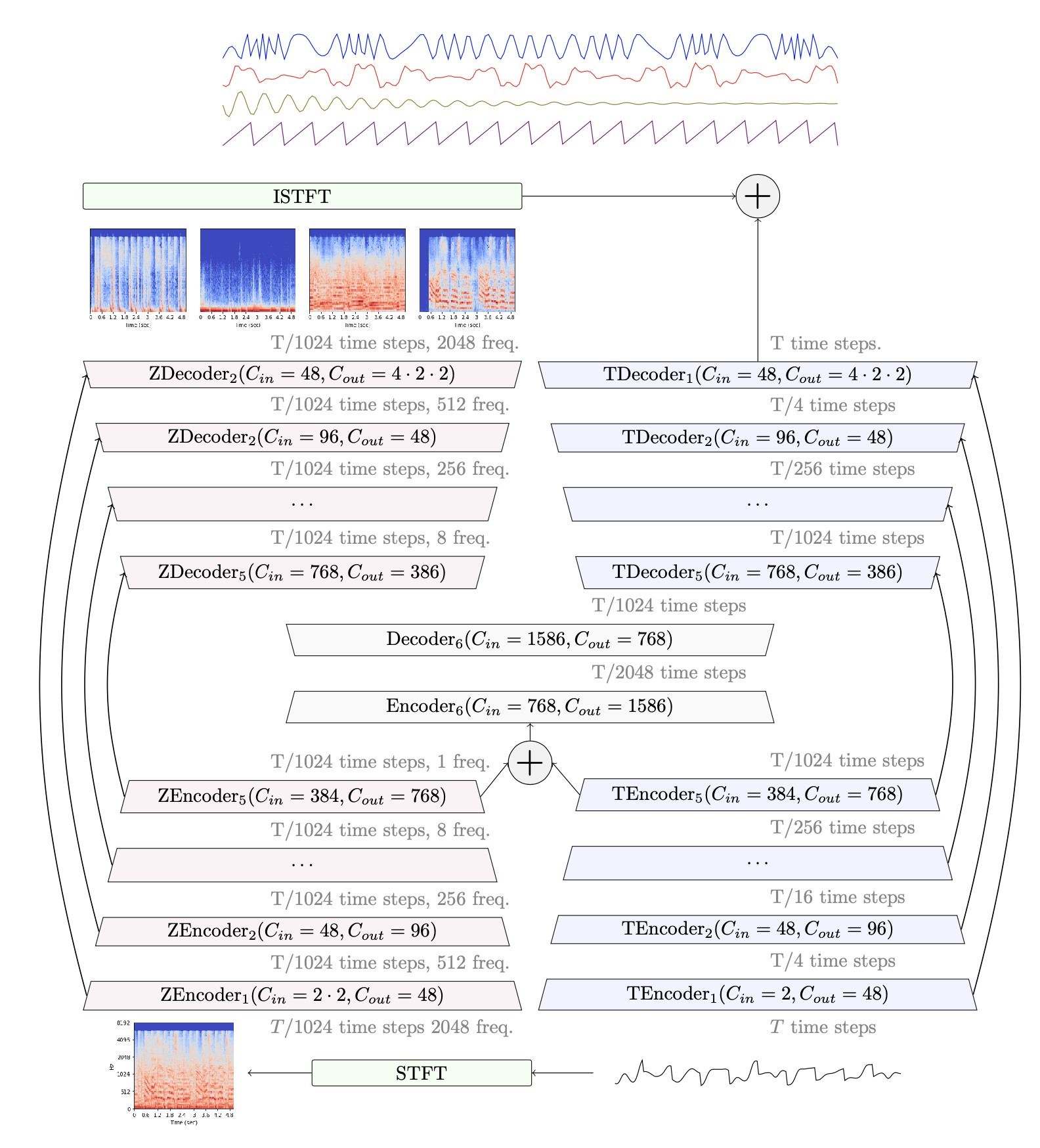
Original figure: A Primer on Source Separation, Figure 2 (Woosung Choi, Alexandre Defossez, Haohe Liu).
Spleeter vs Demucs Benchmark Numbers
These scores on the MUSDB18 test set come from the official Demucs GitHub repository:
| Model | Domain | Extra Training Data | Overall SDR | MOS Quality |
|---|---|---|---|---|
| Spleeter | Spectrogram | 25k songs | 5.9 dB | n/a |
| Demucs v2 | Waveform | None (MUSDB18 only) | 6.3 dB | 2.37 |
| Hybrid Demucs v3 | Hybrid | None (MUSDB18 only) | 7.7 dB | 2.83 |
| HT Demucs fine-tuned v4 | Hybrid | 800 songs | 9.0 dB | n/a |
Signal-to-Distortion Ratio (SDR) measures how cleanly a model separates a source from the mixture. Higher is better, but SDR doesn't replace a listening test. For what to expect from AI stems in practice, see how good AI stem separation is today. The roughly 3 dB gap between Spleeter and Demucs v4 is large in benchmark terms, and Demucs scores higher on every stem, especially drums and vocals.
You can hear the difference in the comparison video below. Demucs stems sound more natural with fewer artifacts, while Spleeter can produce metallic ringing on complex material.

Real-World Performance Implications
Speed: Spleeter processes a 3-minute track in about 2 seconds on GPU. Demucs v4 takes about 20 to 30 seconds. On CPU, Spleeter takes roughly 30 to 60 seconds, and Demucs can take more than 5 minutes.
Hardware: Spleeter runs CPU-only on a laptop with 8GB of RAM. Demucs v4 needs a GPU with 4 to 8GB of VRAM for reasonable speed, and its Transformer layers use much more memory because of the attention matrices.
Artifacts: Because Spleeter reuses the mixture's phase, it can produce "ghostly" vocals and smeared transients. Demucs v4 sounds more natural but can leave low-level noise in silent passages.
Robustness: The SDX'23 challenge showed that Demucs-style architectures cope better with corrupted training data. Spleeter's simpler architecture can't easily benefit from techniques like filtered datasets and loss truncation.
Spleeter or Demucs: Which Should You Use?
Many producers use both, depending on the job.
When to Use Spleeter
Use Spleeter when speed matters: quick a cappellas for DJ sets, karaoke tracks for practice, or batch-processing a whole sample library. Its 100x real-time speed and modest hardware needs are hard to beat, and the quality is enough for remixes where you'll process the stems further.
When to Use Demucs
Choose Demucs v4 when artifacts are unacceptable: stems for official remixes, samples for commercial releases, or close analysis of a performance. The 3 dB quality improvement and phase coherence justify the wait. If you have genre-specific material, fine-tune with extra data, since Demucs's architecture scales better with clean data.
Combining Spleeter and Demucs
Run Spleeter on your whole catalog to find promising tracks, then process the finalists with Demucs. For live performance, pre-separate with Spleeter. For studio work, use Demucs for the cleanest stems. Tools like Ultimate Vocal Remover bundle Demucs alongside other separation models behind a simple GUI.
Do You Need a GPU?
Spleeter runs fine on CPU, while high-quality Demucs workflows really want a GPU. For offline or laptop-friendly batch processing, Spleeter-style models are still useful. For cleaner stems, Demucs and newer hybrid transformer models usually justify cloud processing or a stronger local machine.
2026 Update: What Beats Both Spleeter and Demucs
Spleeter and Demucs are still useful reference points, but they are no longer the quality ceiling for stem separation.
BS-RoFormer (Band-Split RoPE Transformer) splits the spectrogram into frequency bands and models them with Transformer layers. Its paper reports 9.80 dB average SDR on MUSDB18-HQ without extra training data, higher than the 9.0 dB fine-tuned Demucs v4 reached with 800 extra songs. A version trained with 500 extra songs won first place in the music separation track of the Sound Demixing Challenge 2023.
| Model | Year | Overall SDR (MUSDB18) | Extra training data |
|---|---|---|---|
| Spleeter | 2019 | 5.9 dB | 25k songs |
| HT Demucs fine-tuned (v4) | 2022 | 9.0 dB | 800 songs |
| BS-RoFormer | 2023 | 9.8 dB | None |
Mel-Band RoFormer is a close relative that groups frequencies on the mel scale. Community checkpoints of both models now power most high-end vocal and instrumental separators. Our vocal separation model comparison ranks them on real tracks, and the instrument separation model comparison does the same for other instruments.
Neural Analog's AI stem splitter uses BS-RoFormer models for its 4-stem and 6-stem presets, and SAM Audio when you want to extract an instrument the presets do not cover, such as a saxophone or a synth lead. See which models Neural Analog uses for stem splitting for the full list.
Spleeter vs Demucs FAQ
Is Demucs better than Spleeter?
Yes, for quality. Demucs v4 scores about 3 dB higher SDR than Spleeter on the MUSDB18 benchmark and has fewer artifacts on vocals and drums. Spleeter is only better when speed or a CPU-only machine matters more than quality.
Which is better for vocals, Spleeter or Demucs?
Demucs. Spleeter vocals often sound thin or "watery" because Spleeter reuses the phase of the original mix. For the cleanest vocals and instrumentals, a BS-RoFormer or Mel-Band RoFormer model usually beats both.
Is Spleeter still maintained?
Spleeter is still available on GitHub, but it is a 2019 model built on TensorFlow, and its README warns about TensorFlow issues on Apple M1 chips. Most newer tools have moved to Demucs or RoFormer models.
What does Ultimate Vocal Remover (UVR) use?
UVR is a free desktop app, not a single model. It bundles several model families, including Demucs, MDX-Net, and its own VR Architecture models, so its quality depends on which model you pick.
Can I use Demucs without a GPU?
Yes, but it is slow. Expect several minutes per song on a CPU. An online stem splitter runs the model on a server GPU instead. The Studio guide to splitting stems shows the steps.
Related Guides
- Remove the drums from a Suno song: a practical use of drum stem separation.
- Replace AI drums with your own kit: split out the drums, then build a new groove around the vocal.
- Restore MP3 stems to WAV quality: rebuild the highs that compressed sources and separation lose.
- Convert a stereo song to Dolby Atmos: place separated stems in an Atmos mix.
- Install and run AudioSR from GitHub: another open-source audio model to run locally, with Python and PyTorch setup.